
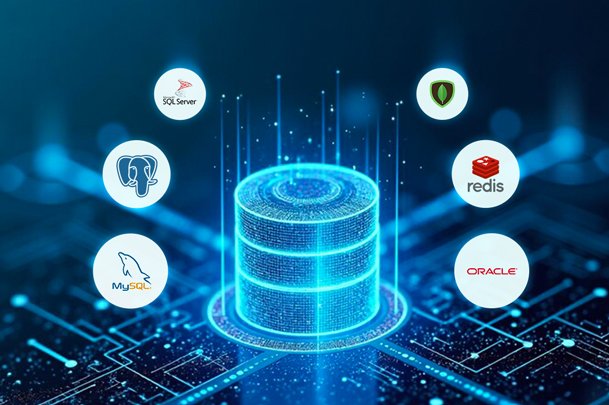





We leverage advanced database technologies to build scalable, secure, and efficient systems for managing and analyzing data. Our expertise spans relational and NoSQL databases, ensuring high performance, reliability, and adaptability to meet diverse business requirements in a data-driven world.
Design and implement systems that grow seamlessly with your business needs.
Enhance query performance and database efficiency for faster operations and reduced latency.
Seamlessly connect databases with applications, APIs, and third-party tools.
Utilize advanced database technologies to organize and analyze data for actionable insights.
At SkySoft, we offer a comprehensive suite of Database Technology solutions tailored to meet your unique business needs. Our expertise spans custom database design, seamless integration, and high-performance management, ensuring innovative solutions that enhance data security, improve efficiency, and drive business growth. We focus on delivering scalable, secure, and future-ready database systems that give you a competitive edge.
MySQL is an open-source, widely-used relational database management system (RDBMS). It is based on the client-server model and is known for its reliability, performance, and ease of use. MySQL has become one of the most popular database systems for web applications.
Key Features:
PostgreSQL is an open-source object-relational database system (ORDBMS) known for its advanced features and standards compliance. It is designed to handle complex queries, large volumes of data, and a variety of data types, offering a lot of flexibility and extensibility.
Key Features:
Microsoft SQL Server is a proprietary RDBMS developed by Microsoft. It is a robust and scalable platform designed for enterprise applications and data management, with powerful integration tools, security features, and a user-friendly interface.
Key Features:
Oracle Database, often referred to simply as Oracle, is one of the most powerful and widely-used relational database systems in the enterprise world. It’s known for its scalability, robustness, and support for complex workloads, including large databases and high-performance applications.
Key Features:
Redis is an open-source, in-memory key-value store that is often used as a database, cache, and message broker. It is designed for high performance and low-latency operations, making it suitable for real-time applications like caching and session storage. Redis supports various data structures, including strings, hashes, lists, sets, and sorted sets, and is widely used for use cases that require fast access to data.
Key Features:
MongoDB is an open-source, document-oriented NoSQL database designed for storing, querying, and processing large volumes of unstructured or semi-structured data. It is based on a flexible schema model, using BSON (Binary JSON) format to store data, which allows for rapid development and scalability. MongoDB is ideal for applications that need to handle large amounts of diverse and dynamic data.
Key Features:
Have questions or big ideas? 💡 Fill out the form below, and we’ll get back to you with the perfect solution!